


In the next few lessons, we will cover Affixes, which are another aspect of the English language often used without conscious thought. However, it’s important for students to learn about affixes as it can help to greatly increase their understanding of how many English words are constructed.
Learning about affixes will also help students to work out the meaning of certain new words without relying on a dictionary, which can serve as a great driver of motivation.
What are affixes?
Affixes are essentially just parts that are added to words to alter their meaning or create new words altogether. The most common types of affixes are prefixes and suffixes.
Prefixes are attached to the front of a word, with the most common being ‘un’. You can see the use of this prefix with a variety of verbs, where it alters the original word to give the opposite meaning:
Undo
Unable
Unafraid
Suffixes are additions at the end of a word that alter the meaning, create a new word or change its grammatical function. A common suffix is ‘er’, which can be attached to verbs to create a noun, or adjective:
Trainer
Walker
Happier
Affix examples
There are many types of prefix and suffix in the English language, each with different meanings and rules of use. Check out these examples below:
| Prefix | Meaning | Example |
|---|---|---|
| mis | wrongly, incorrectly | misunderstand, misheard. |
| multi | many | multitool, multicultural. |
| pre | before | predetermined, precede, preview. |
| re | again | relive, revisit, realign. |
| Suffix | Meaning | Example |
|---|---|---|
| able | ability | likeable, doable. |
| dom | a state | freedom, boredom. |
| less | lacking, without | voiceless, meaningless. |
| en | change state, become | broaden, harden. |
Affixes – Rules of use
When it comes to teaching students about affixes, there are certain rules and notes which can be useful to learn.
These rules can enable students not only to decipher the meaning of certain words, but also to create their own words without help. This might not seem like such a big step, but it’s a huge moment in a student’s journey when they first piece together a new word for themselves, and can give them a great sense of achievement.
Prefix rules
Students will often struggle to match prefixes with compatible base words. For example, it’s easy for a native speaker to see that “unlegal/imlegal” is incorrect, however, new learners won’t be aware of this.
Luckily, when it comes to negative prefixes (ones that change a word to hold an opposite meaning) there are a number of rules which can be applied in most situations for matching suitable prefixes with base words:
Rough negative prefix rules:
Words starting with ‘l’ have the prefix ‘il’ – illegal, illegible
Words starting with ‘r’ use the prefix ‘ir’ – irrelevant, irresponsible
Words starting with ‘m’, ‘b’ or ‘p’ use ‘im’ – impatient, immature, imbalance
This won’t help students to match all base words with a correct prefix, but it’ll help when dealing with many negative prefixes – which are one of the most common uses.
Suffix rules
Suffixes can be tricky, as there aren’t many rules that can be widely applied, however there are a few points that students should be made aware of.
First, students should know that unlike prefixes, suffixes can change the spelling of the original word. This can often make it difficult for students to pick out the base word from the suffix itself.
For example:
Beauty + ‘ful’ = beautiful
Second, similar to prefixes, not all suffixes can be applied to all base words. However, with suffixes there’s less of a structure to which words can take which suffixes, and your students will have to learn and memorize these on a word-by-word basis.
Third, each suffix can have a different meaning depending on what type of word it is attached to, and these will also have to be memorized.
For example:
‘er’ + big = bigger (more big)
But
‘er’ + train = trainer (someone who trains)
As these can be a little complicated for new teachers, in the next page we’ll look at some further tips for introducing affixes to your students.
Affixes – Teaching affixes
It can help to start by first introducing common ones such as the prefix ‘un’ or suffix ‘ly’. This will ensure that your students encounter them regularly, and can build their knowledge of how these specific affixes are used with a number of different words.
It can also be overwhelming for students to learn about prefixes and suffixes at the same time. As such, it can be easier for them to start with prefixes, and then move on to suffixes at a later point.
Techniques for teaching affixes
Once your students understand what affixes are, you can use some of the following techniques to help your class practice using them.
💡 Useful techniques:
• Draw attention to affixes when they come up naturally in your lessons. By breaking words down into their different parts, students will start to analyze words for themselves and build a greater understanding of how specific affixes are used.
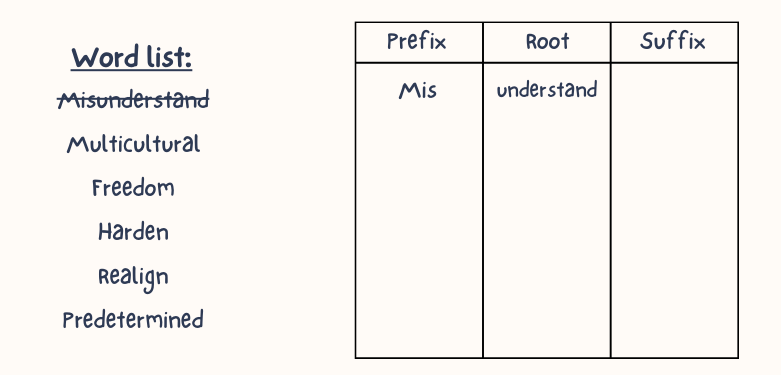
• Divide students into groups, then give each group a pile of word cards and a chart with three columns. Each group should work together to cut the words apart, into their root, suffix, and prefix, and arrange them in the appropriate columns.
• Put a number of cards face down on the table. Each card should have a word that your students know well and can be combined with a suffix or prefix that they also know. Then have students take it in turns to pick a card and say the word on its underside, but with an affix added. If correct, they get to keep the card or gain a point.
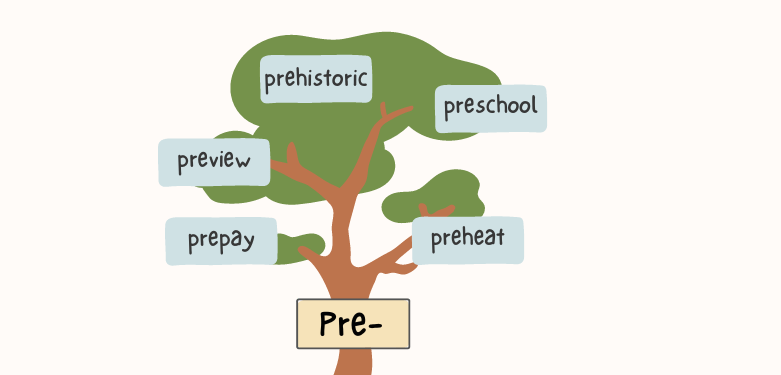
• Introduce a specific prefix or suffix and help your students to build a ‘word tree‘ by listing all the different words which can use this affix. This can be turned into a competition by splitting the class into groups, and having them compete to create the tree with the most correct words.
You’re a smart Banana! *sticks gold star on your forehead*
 Teacher Lizzy
Leave a comment